From Discovery to Application
Our goal is to develop cutting-edge genomic and spatial approaches that improve both our understanding of biodiversity and our ability to conserve it as landscapes and climates change.
Our research integrates whole-genome sequencing with landscape and environmental modelling to understand the ecological and evolutionary processes that structure insect diversity across space and through time. We use population genomics to quantify population structure, neutral and adaptive genomic diversity, inbreeding, and differentiation, and combine these analyses with models of habitat suitability, environmental variation, and connectivity to understand how land use, climate, and geographic isolation shape biodiversity.
A major focus of the lab is generating large, multi-species whole-genome datasets and using them to move beyond isolated species-level studies. By standardizing genomic and landscape approaches across species, we can ask how genomic diversity and differentiation are structured by isolation by distance, isolation by resistance, and isolation by environment, and identify broader ecological and evolutionary commonalities among insects. We also use forward-in-time landscape and environmental modeling to predict how habitat suitability and connectivity may change under alternative climate scenarios and how these changes may affect genomic diversity and adaptation.
Much of this work is directly applied to conservation. We collaborate with conservation agencies across North America to study endangered and at-risk insects and develop management strategies that translate genomic and ecological data into conservation decisions. Our work addresses questions including population connectivity, genomic diversity, inbreeding, local adaptation, conservation prioritization, and when interventions such as genetic rescue or translocation are warranted.
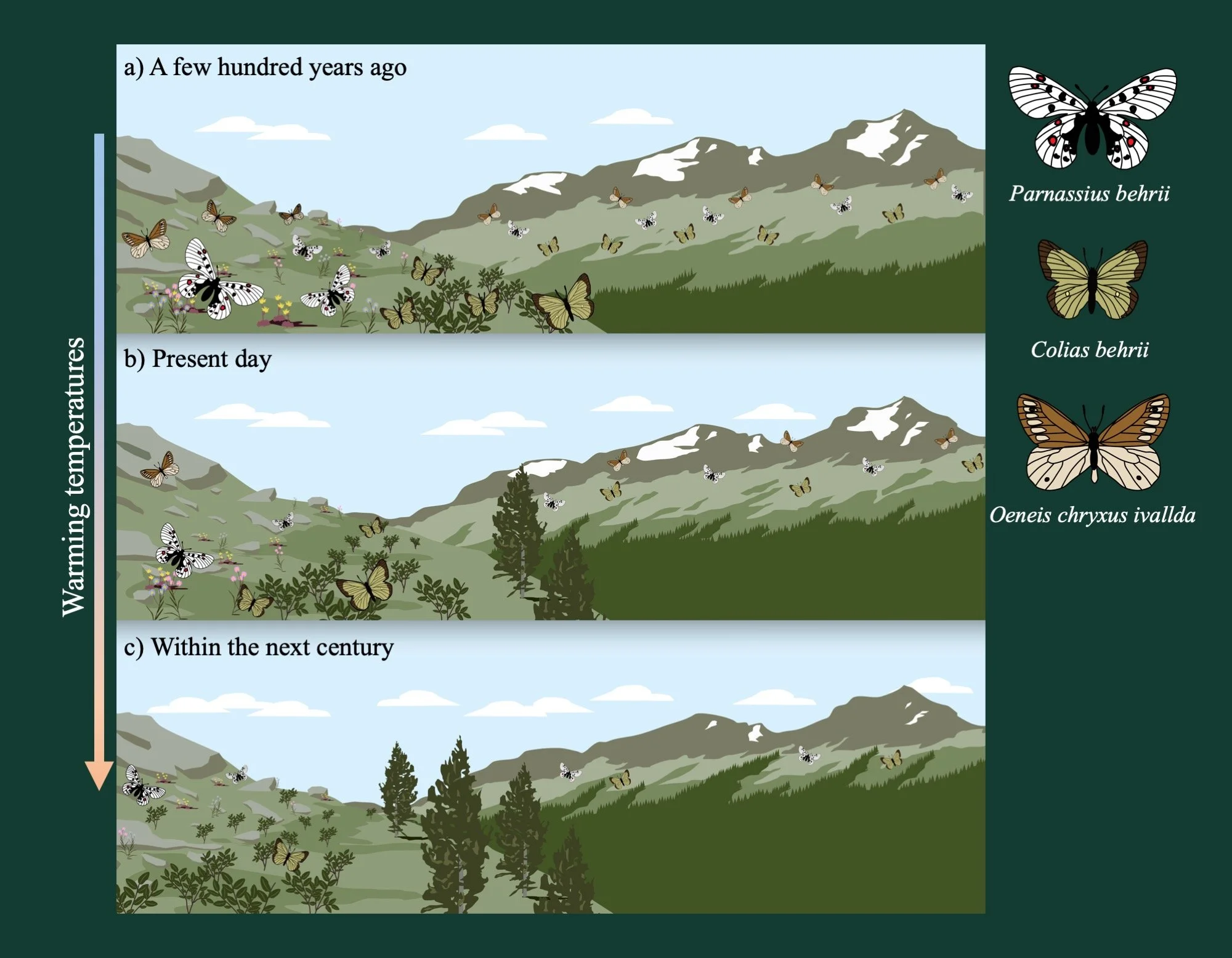
This illustration shows how warming temperatures are reshaping alpine butterfly distributions in California’s Sierra Nevada, from historical conditions through the present and into the next century. By integrating whole-genome sequencing with forward-in-time ecological and landscape modeling, we aim to predict how changes in habitat suitability and connectivity may influence population persistence, genomic diversity, and opportunities for adaptation.
Publications
For a full list of publications, see [Google Scholar]. https://scholar.google.com/citations?user=ZvjBZNoAAAAJ&hl=en&oi=ao
2026
MacDonald, Z. G., Beninde, J., Dupuis, J. R., Gillespie, T. W., Shaffer, H. B., & Grether, G. F. (2026). From lineage discovery to conservation prioritisation: An integrative genomic framework applied to a model damselfly system. Molecular Ecology, 35(11). https://doi.org/10.1111/mec.70385
MacDonald, Z. G., Curti, J. N., Cooper, R., Schoville, S. D., Escalona, M., Chumchim, N., Fairbairn, C. W., Toffelmier, E., Miller, C., Marimuthu, M. P. A., Nguyen, O., Seligmann, W., Gillespie, T. W., & Shaffer, H. B. (2026). Genome assembly for the Sierra Nevada Parnassian (Parnassius behrii) and a brief review of butterfly genome sizes. Journal of Heredity, 117(4), 888–900. https://doi.org/10.1093/jhered/esaf093
Halsch, C. A., Forister, M. L., Skinner, G. L. V., Outhwaite, C. L., Belitz, M. W., Maharaj, G., Code, A., Guzman, L. M., Van Deynze, B., Steibl, S., Stoll, E., De Knijf, G., Dittemore, C. M., Gath, L., Fowler-Finn, K., Bal, P., Marsh, J. R., Jadhav, A., Owens, A. C. S., Muchoney, N. D., Tatarko, A. R., Dániel-Ferreira, J., Öckinger, E., Franzem, T. P., Barrett, M., MacDonald, Z. G., Latty, T., MacMillan, H. A., Pohl, G. R., Richards, L. A., Ryalls, J. M. W., Staab, M., Stack Whitney, K., Woodcock, B. A., Bahlai, C. A., Grames, E. M., Ware, J. L., Elphick, C. S., & Wagner, D. L. (2026). Drivers of insect decline: Direct, indirect, and combined pressures. Annals of the Entomological Society of America. https://doi.org/10.1093/aesa/saag037
Acorn, B. H. G., MacDonald, Z. G., Park, K. Y., Frost, C. M., & Glasier, J. R. N. (2026). Species biology, morphology, and behaviour of the endangered curiously isolated hairstreak butterfly (Satyrium curiosolus; Lycaenidae). Journal of Insect Conservation, 30(4). https://doi.org/10.1007/s10841-026-00795-8
Keating-Elske, L. M., Glasier, J. R. N., Burns, L. D., Dupuis, J. R., Haines, L., Hébert, L., Henault, J., Heron, J., Linton, J. E., MacDonald, Z. G., Sperling, F. A. H., & Sissons, R. A. (2026). Using constructed value of information to identify key uncertainties for a decision tree analysis in iterative structured decision making. Conservation Science and Practice, 8(2). https://doi.org/10.1111/csp2.70228
Norris, J., Katz, S., Lui Stemp, E., Stevenson, C., Bass, B., Cohen, N. L., Finzi Hart, J., Fournier, E., Li, Z., Zhang, J., Darling, R., Gonser, M., Habre, R., Hu, H., Kampalath, R., Lazarus, D., MacDonald, Z. G., McCracken, A., Esmaeili Neyestani, S., Reyna, E., Teh, A., Vega Varela, N., Wei, V., Yu, W., & Zhang, X. (2026). Los Angeles Regional Synthesis Report (California’s Fifth Climate Change Assessment). University of California, Los Angeles.
2025
MacDonald, Z. G., Dupuis, J. R., Glasier, J. R. N., Sissons, R., Moehrenschlager, A., Shaffer, H. B., & Sperling, F. A. H. (2025). Whole-genome evaluation of genetic rescue: The case of a curiously isolated and endangered butterfly. Molecular Ecology, 34(4). https://doi.org/10.1111/mec.17657
MacDonald, Z. G., Dupuis, J. R., Glasier, J. R. N., Sissons, R., Moehrenschlager, A., Shaffer, H. B., & Sperling, F. A. H. (2025). Genomic and ecological divergence support recognition of a new species of endangered Satyrium butterfly (Lepidoptera, Lycaenidae). ZooKeys, 1234, 291–307. https://doi.org/10.3897/zookeys.1234.143893
MacDonald, Z. G., Schoville, S., Escalona, M., Marimuthu, M. P. A., Nguyen, O., Chumchim, N., Fairbairn, C. W., Seligmann, W., Toffelmier, E., Gillespie, T., & Shaffer, H. B. (2025). A genome assembly for the Chryxus Arctic (Oeneis chryxus), the highest butterfly in North America. Journal of Heredity, 116(3), 324–334. https://doi.org/10.1093/jhered/esae051
2024
MacDonald, Z. G., Gillespie, T., & Shaffer, H. B. (2024). The highest butterfly in North America. Frontiers in Ecology and the Environment, 22(1). https://doi.org/10.1002/fee.2707
MacDonald, Z. G., Shaffer, H. B., Sperling, F. A., Cork, S., & Whiteside, D. (2024). Impacts of land use and climate change on natural populations: The butterfly perspective. In Case Studies in Eco Health (pp. 109–131). 5M Books.
2023
Grether, G. F., Beninde, J., Beraut, E., Chumchim, N., Escalona, M., MacDonald, Z. G., Miller, C., Sahasrabudhe, R., Shedlock, A. M., Toffelmier, E., & Shaffer, H. B. (2023). Reference genome for the American rubyspot damselfly, Hetaerina americana. Journal of Heredity, 114(4), 385–394. https://doi.org/10.1093/jhered/esad031
Roe, A. D., MacDonald, Z. G., Snape, K. L., & Sperling, F. A. H. (2023). Genome-wide markers show continental structuring and mitonuclear discordance in the forest tent caterpillar (Malacosoma disstria Hübner) (Lepidoptera: Lasiocampidae). The Canadian Entomologist, 155. https://doi.org/10.4039/tce.2023.13
2022
MacDonald, Z. G., Snape, K. L., Roe, A. D., & Sperling, F. A. H. (2022). Host association, environment, and geography underlie genomic differentiation in a major forest pest. Evolutionary Applications, 15(11), 1749–1765. https://doi.org/10.1111/eva.13466
Liu, J., MacDonald, Z. G., Si, X., Wu, L., Zeng, D., Hu, G., Ding, P., & Yu, M. (2022). SLOSS-based inferences in a fragmented landscape depend on fragment area and species–area slope. Journal of Biogeography, 49(6), 1075–1085. https://doi.org/10.1111/jbi.14366
Campbell, E. O., MacDonald, Z. G., Gage, E. V., Gage, R. V., & Sperling, F. A. H. (2022). Genomics and ecological modelling clarify species integrity in a confusing group of butterflies. Molecular Ecology, 31(8), 2400–2417. https://doi.org/10.1111/mec.16407
Nelson, T. D., MacDonald, Z. G., & Sperling, F. A. H. (2022). Moths passing in the night: Phenological and genomic divergences within a forest pest complex. Evolutionary Applications, 15(1), 166–180. https://doi.org/10.1111/eva.13338
2021
MacDonald, Z. G., Deane, D. C., He, F., Lamb, C. T., Sperling, F. A. H., Acorn, J. H., & Nielsen, S. E. (2021). Distinguishing effects of area per se and isolation from the sample-area effect for true islands and habitat fragments. Ecography, 44(7), 1051–1066. https://doi.org/10.1111/ecog.05563
2020
Sperling, J., MacDonald, Z., Normandeau, J., Merrill, E., Sperling, F., & Magor, K. (2020). Within-population diversity of bacterial microbiomes in winter ticks (Dermacentor albipictus). Ticks and Tick-Borne Diseases, 11(6), 101535. https://doi.org/10.1016/j.ttbdis.2020.101535
MacDonald, Z. G., Dupuis, J. R., Davis, C. S., Acorn, J. H., Nielsen, S. E., & Sperling, F. A. H. (2020). Gene flow and climate-associated genetic variation in a vagile habitat specialist. Molecular Ecology, 29(20), 3889–3906. https://doi.org/10.1111/mec.15604
2019
MacDonald, Z. G., Acorn, J. H., Zhang, J., & Nielsen, S. E. (2019). Perceptual range, targeting ability, and visual habitat detection by greater fritillary butterflies Speyeria cybele (Lepidoptera: Nymphalidae) and Speyeria atlantis. Journal of Insect Science, 19(4). https://doi.org/10.1093/jisesa/iez060
2018
MacDonald, Z. G., Anderson, I. D., Acorn, J. H., & Nielsen, S. E. (2018). The theory of island biogeography, the sample-area effect, and the habitat diversity hypothesis: Complementarity in a naturally fragmented landscape of lake islands. Journal of Biogeography, 45(12), 2730–2743. https://doi.org/10.1111/jbi.13460
2017
MacDonald, Z. G., Anderson, I. D., Acorn, J. H., & Nielsen, S. E. (2017). Decoupling habitat fragmentation from habitat loss: Butterfly species mobility obscures fragmentation effects in a naturally fragmented landscape of lake islands. Oecologia, 186(1), 11–27. https://doi.org/10.1007/s00442-017-4005-2
MacDonald, Z. G., Nielsen, S. E., & Acorn, J. H. (2017). Negative relationships between species richness and evenness render common diversity indices inadequate for assessing long-term trends in butterfly diversity. Biodiversity and Conservation, 26(3), 617–629. https://doi.org/10.1007/s10531-016-1261-0